


Best Responses to the failed US/Canada Trade Deal
Updated: Aug 24

ugust 24 2026
Taken from FACEBOOK.
April 21 2026

April 24 2026

Robert Frawley

·
THE FACTS DON'T " LIE "!
- Failed to secure a satisfactory Gordie Howe Bridge revenue deal.
- Failed to prevent a major breakdown in Canada-U.S. trade relations.
- Failed to protect Canadian exporters from escalating U.S. tariffs.
- Failed to provide stability and certainty for Canadian businesses.
- Failed to secure a clear, reliable future for the USMCA trade agreement.
- Failed to adequately ease Canada's cost-of-living pressures.
- Failed to make housing genuinely affordable for average Canadians.
- Failed to close Canada's massive housing supply gap.
- Failed to bring federal deficits under meaningful control.
- Failed to deliver the fiscal discipline Canadians were promised.
- Failed to reduce Canada's rapidly growing national debt.
- Failed to reverse Canada's long-standing productivity decline.
- Failed to create the business environment needed to attract investment.
- Failed to fully capitalize on Canada's enormous energy potential.
- Failed to turn pipeline and energy promises into completed projects.
- Failed to establish a consistent, sustainable immigration strategy.
- Failed to prevent temporary-resident growth from overwhelming infrastructure.
- Failed to deliver major infrastructure projects quickly enough.
- Failed to justify the enormous increase in defence spending to taxpayers.
- Failed to make Canada sufficiently competitive through lower costs and smarter regulation.
- Failed to reduce Canada's dangerous dependence on the U.S. economy.
- Failed to diversify Canadian trade quickly enough to offset U.S. dependence.
- Failed to deliver meaningful relief from rising everyday expenses.
- Failed to turn ambitious announcements into enough completed projects and jobs.
- Failed to deliver the stronger, more prosperous Canada promised to voters.
Michael Law Cobb
There’s a reason a lion doesn’t wake up one morning, look across the savannah at a 12,000-pound elephant and think:
"Today's the day I teach that bastard a lesson."
It’s not cowardice.
It’s understanding leverage.
The elephant is bigger.
The elephant is stronger.
And your motivational speech about standing up for yourself doesn't magically make the elephant smaller.
Never confuse courage with leverage.
Canada can be proud, independent and tough.
But we're negotiating with the largest economy on Earth, sitting directly beside us, buying hundreds of billions of dollars of Canadian goods every year.
And behind that negotiating position sits the most powerful military apparatus on the planet.
That's not an insult to Canada.
That's arithmetic.
You negotiate accordingly.
You don't walk into a heavyweight fight weighing 145 pounds, slap the heavyweight champion across the face, and then give a press conference about how brave you were when you wake up.
Trump understands something very simple:
Negotiations ultimately happen underneath a hierarchy of economic, political and military power.
You don't have to like that.
You don't have to like him.
You don't even have to think it's fair.
But pretending the hierarchy doesn't exist doesn't make Canada stronger.
Pick the fight you can win!
And if you can't win it?
Make a deal.
Then go home and build enough strength that next time, you negotiate from a bigger chair.
A chihuahua barking at an Elephant might technically be "standing its ground."
It's also still a chihuahua.
Angela Shelley
·

People need to stop pretending the United States just woke up one morning and decided to “pick a fight with Canada.”
That is not what this is.
This is a fight over who gets access to the American market, what they are allowed to sell into it, where those products are made, and whether North America continues hollowing out its own manufacturing base while becoming more dependent on China.
Canada sends roughly 72% of its merchandise exports to the United States.
Read that again.
The U.S. is not some optional customer for Canada. The American consumer market is the foundation of an enormous share of Canadian trade.
So yes, the United States has leverage.
And using that leverage to demand stronger North American production, tighter rules of origin, more domestic content, more manufacturing jobs, and less dependence on Chinese supply chains is not “picking a fight.”
It is called negotiating from strength.
For years, everyone has been perfectly comfortable benefiting from access to the American consumer while manufacturing more and more somewhere else.
That model has consequences.
Lost factories.
Lost industrial capacity.
Lost jobs.
Critical supply chains controlled overseas.
Entire industries dependent on countries that may not always be our allies.
At some point, somebody has to say:
Enough.
If you want privileged access to the North American market, then build more in North America.
Employ North Americans.
Source more here.
Manufacture more here.
Protect the industries that actually matter when the world becomes unstable.
Canada should defend Canadian interests.
Mexico should defend Mexican interests.
And the United States should absolutely defend its own.
That does not make Canada the enemy.
It means the era of assuming unlimited access to the American market without serious conditions is being challenged.
Tariffs are painful. Trade wars have costs.
But so does spending another generation outsourcing our industrial base and pretending cheap imports are worth surrendering economic independence.
This is bigger than one tariff.
This is bigger than one country.
This is about whether North America remains capable of making what it needs, employing its own people, and controlling its own economic future.
That is the fight.
And that is what people are completely missing.
100% for Melanie. Well Written Synopsis. And she added a Trudeau gaffe in there too. See if you can spot it. Re-printed without permission.
The Most Convenient Failed Trade Deal in Canada
The Most Convenient Failed Trade Deal in Canada
Canada got 50 per cent tariffs, businesses got uncertainty and taxpayers got the bill. Mark Carney got a perfectly timed diversion for something considerably more useful...
Melanie In Saskatchewan
Aug 23, 2026
I’ve spent an unreasonable amount of time listening to Mark Carney explain why Canada walked away from the U.S. trade deal. I listened to the speech, read the statement, read Washington’s version, went back through the reporting, then listened again because apparently recreational aggravation is how I spend my time now.
And after everything I’ve seen, I have some… thoughts.
Imagine, if you will, a prime minister first installed and then elected, because Canadians believed he was uniquely equipped to deal with Donald Trump. Our hypothetical prime minister has impeccable credentials, international connections, central banking experience, serious suits, and the reassuring manner of a man who appears to know exactly which fork to use while the dining room burns down around him.
Most importantly, his political identity rests on one enormously useful proposition: Only he can handle Trump.
Now imagine the negotiations aren’t going particularly well. Not outright disastrous, at least not yet. Just difficult. Canada makes concessions. Ottawa drops the Digital Services Tax, removes most retaliatory tariffs, and American alcohol and supply management are on the table.
Still, negotiations continue, but then something changes.
On August 18, Trump postpones the new 50 per cent tariffs for three days after the two sides report “substantial progress.” By August 20, Canada’s trade minister says they’re “very close” to a deal. Reporting suggests the agreement under discussion could halve steel and aluminum tariffs and reduce tariffs on Canadian-built vehicles from 25 to 15 per cent.
And then… poof!
No deal. Do not pass go, consider this farce terminated.
The 50 per cent tariffs take effect. Carney suspends negotiations, the Canadian negotiators come home, and Ottawa announces retaliation. Washington says Canada backed away from commitments while Ottawa resolutely asserts Washington changed the terms at the last minute.
Well, that’s pretty fricking interesting, isn’t it?
So naturally our hypothetical prime minister takes to the airwaves and explains exactly what happened. Except he doesn’t, not with any actual clarity.
He speaks for more than twenty minutes, probably moistly, wandering from storms and changing climates to sovereignty and resilience, then through infrastructure, LNG, nuclear power, housing, defence, diversification and investment. By the time he finishes, we’ve practically navigated the entire federal government, several industries and the weather forecast.
Canada, we learn, is “master in our own home.” Well, isn’t that just terrific! What happened to the bloody trade deal?! Carney says the Americans introduced new terms that were “uneconomic” and “unfair.”
They “asked too much and offered too little.” Who is going to draw the short straw and tell Carney those are adjectives and conclusions, and not terms?
Then comes a particularly curious bit. Carney says Washington also sought restrictions affecting Canada’s future trade relationships with other countries.
Other… countries.
But he never actually tells us which countries Washington was talking about, exactly what restrictions were being demanded, or which “certain sectors” he meant when he admitted the Americans wanted Canada to coordinate tariffs against other countries. Stranger still, Carney conceded that Canada could actually see merit in some of it as part of the right deal.
So which countries? Which sectors? And which parts of this supposedly unacceptable assault on Canadian sovereignty did you actually find reasonable? Suddenly the man who just spent twenty minutes talking develops an acute shortage of proper nouns.
China is rather conspicuously standing nearby, of course. Washington has openly sought to reduce North American reliance on Beijing while Carney has moved toward closer economic ties with China after campaigning in 2025 calling China Canada’s biggest security threat.
Was China one of those unnamed countries? I don’t know, and neither do you. And that, my friends, is the point.
If Washington demanded something outrageous, then tell us. If America demanded Canada surrender control over its trade policy, then show us. Or spare us the dramatic sovereignty recital until you’re prepared to identify what, precisely, our sovereignty was being rescued from. The adults paying for this have their big-girl and big-boy underwear on by now, we’re adults. We can handle the frightening nouns.
If Carney just protected some fundamental Canadian interest from American interference, surely Canadians can be trusted with enough information to understand what it was! Instead we’re told the house was saved from a terrible intruder, but apparently asking what the intruder wanted is terribly gauche.
Now… put that clue aside. There’s another one. Washington tells a completely different story.
U.S. Trade Representative Jamieson Greer says Canada declined to finalize terms previously agreed to and backed away from commitments. The American account says meaningful tariff relief was on the table. Reuters confirms the negotiations had reached the point where reductions involving steel, aluminum and autos were being discussed.
Maybe Greer is full of it, that’s entirely possible. He’s an American trade negotiator defending an American administration. Nobody needs to knit the man a credibility cardigan.
But notice the problem… both sides accuse the other of changing the deal. And Canadians haven’t seen enough of the deal to determine who is telling the truth. It’s quite disconcerting that Canadians feel they need to ask for, as well as physically see, the indisputable evidence of the truth with their own eyes before accepting the word of the prime minister in the first place!
That is not a minor detail, that is the crux of the mystery.
Now we come to timing. Three federal by-elections are being held August 31. Advance voting began August 21. The trade deal collapsed August 21.
It’s here we need to head off the inevitable convenient but false defence from all the exhausted and overworked Liberal water carrying pundits that important international events sometimes collide accidentally with election calendars.
Because this wasn’t simply an election calendar that happened to Carney. Carney chose the by-election date. He called the three by-elections for August 31 while the Canada-U.S. trade confrontation was already well underway and the negotiating calendar was hardly a state secret.
The immediate American tariff deadline was originally August 19 and Trump subsequently moved it three days while negotiations continued at Carney’s request. So no, Carney could not have known in July that the agreement would collapse specifically on August 21. That would be claiming something the evidence doesn’t establish. But he, and only he, could certainly orchestrate it.
But he definitely knew the major trade negotiations and tariff deadlines would be unfolding in the same political window when he chose August 31 for the by-elections.
Carney didn’t choose Washington’s calendar, but he did choose his own knowing the other one was already hanging on the wall. That proves nothing about motive. But in our little drawing-room mystery, we don’t throw away a clue merely because it arrived wearing sensible shoes.
And suddenly the timing becomes a little more interesting, because our hypothetical prime minister has a political problem. Suppose he signs the deal. Now he has to explain the concessions, whether they involve dairy, alcohol, digital policy, restrictions involving third countries, or perhaps other things we still don’t know about because, once again, we haven’t seen the damn thing.
And after campaigning as the man uniquely equipped to stand up to Trump, concessions aren’t particularly photogenic now, are they?
But suppose he walks away? Something rather fascinating happens: he no longer has to defend any of those concessions. Instead, he gets to defend Canada. The story quietly transforms from Mark Carney failed to secure the trade agreement his supposedly unmatched experience was meant to deliver into Mark Carney refused to surrender to Donald Trump.
Same failed negotiation, entirely different political story. And just like that, failure gets promoted to courage, which brings us to the question every decent mystery eventually asks.
So who, exactly, benefits?
Certainly not manufacturers staring down 50 per cent tariffs, workers whose jobs depend on American customers, farmers, small businesses, or consumers about to enjoy Ottawa’s retaliatory tariffs at the checkout.
But taxpayers? We get the privilege of financing the relief package for the damage. Apparently that’s our contribution to the negotiations.
Ottawa already has billions committed to programs, loans, financing and other measures responding to the broader trade conflict. Now more assistance is coming. Meanwhile, the new 50 per cent tariffs affect roughly US$20 billion in Canadian exports, and there are currently no further negotiations scheduled.
There’s something almost artistically Canadian about this. America taxes our exports, Ottawa retaliates by taxing our imports, then reaches into our pockets to fund relief for the resulting damage of the fall out.
And somewhere in Ottawa, someone in the PMO communications room puts ECONOMIC RESILIENCE on a PowerPoint slide and waits for applause. Meanwhile, the people already standing in food-bank lines get the practical version of sovereignty. If this keeps up, they’ll need to start arriving at two in the morning like concert fans trying to get front-row tickets to the Dry Cereal & Kraft Dinner debut.
Carney, meanwhile, risks nothing quite so vulgar as a paycheque, a business or a grocery budget. His risk is political. Conveniently, so is his potential reward. Which brings us back to our hypothetical.
Imagine a prime minister whose greatest political asset is standing up to Donald Trump, approaching a deal that would require politically unpleasant concessions, with three by-elections he scheduled sitting right in the middle of the trade fight.
Then advance voting begins. The deal collapses. And our prime minister spends twenty minutes explaining why he walked away while remaining remarkably vague about some of the demands that supposedly made walking away necessary.
So what changed? Who pays? Who benefits? Why are the “other countries” still unnamed, and why can’t Parliament see enough of the rejected deal to judge it? And what explanation would make all these otherwise peculiar little facts sit together more comfortably? At some point, coincidence stops answering questions and starts creating them.
Now step outside the hypothetical. There is no irrefutable evidence proving Mark Carney deliberately killed this agreement for personal political advantage.
Maybe walking away was the right decision. Maybe Washington’s final demands really were intolerable. Maybe Carney really did protect Canada from a rotten deal, as hard as that is to believe.
Well, if that is the case then there is a remarkably easy way to make this entire theory look ridiculous.
Show us.
Name the countries. Identify the restrictions. Tell Parliament what materially changed. Show enough of the rejected agreement to explain how Canada went from “very close” to a deal one day to walking away the next. Until then, we’re left with what we actually know.
Carney was sold as the man uniquely equipped to handle Trump. The deal got close. The deal collapsed. Canada got 50 per cent tariffs. Businesses got uncertainty. Workers got risk. Taxpayers got the damage-control bill.
And Carney? He got to become the man seen standing up to Trump all over again. The elbows up crowd is very likely mass ordering fainting couches right now, so overcome with reverent worship they’re practically prostrating themselves.
Maybe we’re watching a spectacular political failure. Or, and hear me out here… just maybe we’ve been looking at the mystery backwards.
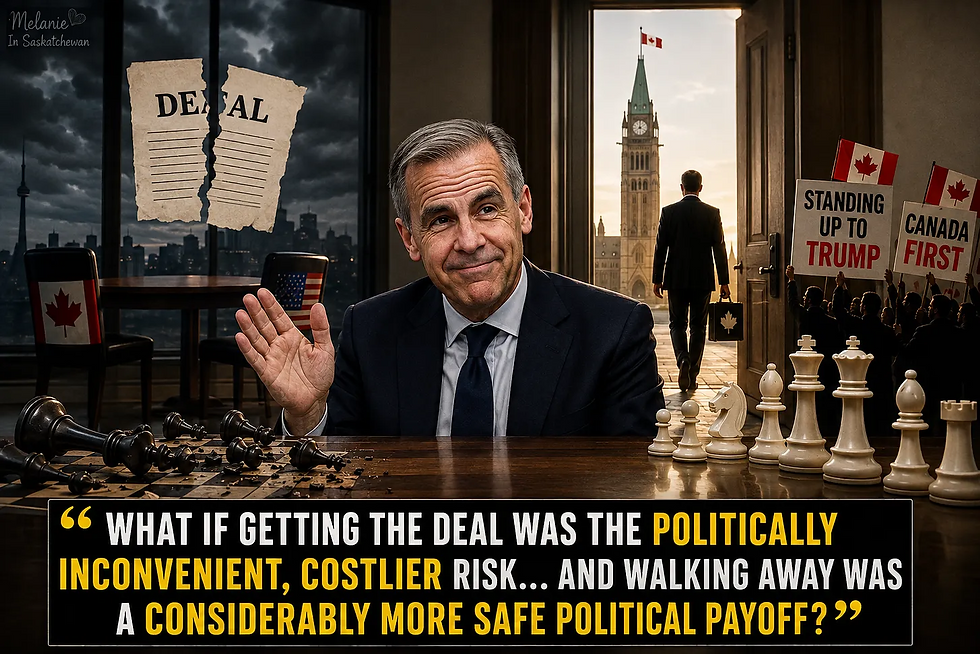
What if getting the deal was the politically inconvenient, costly risk… and walking away was a considerably more safe political payoff? 🤔
Melanie
Canadians Against Overreach
Sean Chevrier
·
🇨🇦 CANADA: WHERE FREE TRADE COMES WITH A TERMS & CONDITIONS PAGE 🤡
Seriously… explain this one to me.
Canada loves giving speeches about free trade, fighting American tariffs and telling the world how important it is for Canadian businesses to access markets.
Meanwhile, right here at home, we still have interprovincial trade barriers.
Yep. Canada.
A country of about 40 million people, divided into 10 provinces and 3 territories, where a business can sometimes face different rules, standards, licensing requirements, regulations and procurement restrictions just because it wants to sell its product or service to another province.
🤡 Ontario → Quebec? Different regulatory requirements can apply.
🤡 Alberta → B.C.? Different rules and professional licensing can create extra hurdles.
🤡 Truckers crossing provincial borders? Welcome to Canada's regulatory maze.
🤡 Workers with qualifications from one province? Sometimes those qualifications don't automatically translate into another province.
And then politicians look at the economy and say:
"We need to diversify trade!"
Maybe start by letting Canadians trade with Canadians without needing a fucking decoder ring. 😂
This isn't an argument for removing legitimate health, safety or environmental standards.
It's about eliminating unnecessary duplication and protectionism that makes it harder for Canadian businesses to operate across their own country.
The federal government has been working through the Canadian Free Trade Agreement, and provinces have made progress removing some barriers—but we're still nowhere near a truly seamless internal market.
Think about how ridiculous that is.
We have politicians screaming about a 10%, 25% or whatever-the-hell tariff coming from Washington…
while Canadian businesses can still run into Canadian-made barriers inside Canada.
Maybe before we lecture the Americans about free trade, we should make sure Canada actually has free trade.
Because apparently our national economic strategy is:
"Build one Canada… but make 13 different instruction manuals." 🇨🇦🤦♂️

Comments